
Knapsack and Handheld Sprayers: Buying and Calibration Guide
- 12 October 2026
- Peter Greenley
Guides › Sprayers · Last updated 12 October 2026 · TreeMarker
For forestry and amenity weed control, a 15–18 litre knapsack sprayer is the standard tool, with handheld compression sprayers from 1.5–8 litres used for spot treatment. The main choice is diaphragm pump (reliable at lower pressures, tolerant of wettable powders) versus piston pump (higher pressure for longer reach). Anyone applying professional plant protection products in the UK must hold a recognised certificate of competence. TreeMarker stocks Cooper Pegler and Berthoud from £17.95 ex VAT.
Certification and the law. In the UK, professional users of plant protection products must hold a recognised certificate of competence. For handheld and knapsack equipment this is normally PA1 (the foundation module covering legislation, labels, personal safety, environmental risk and storage) plus PA6 (the practical module for pedestrian handheld applicators). You must also follow the product label, complete a COSHH assessment, and observe any buffer zones or restrictions near watercourses. Always check current requirements with the HSE before applying anything. This guide covers equipment, not the products applied through it.
Sprayers at a glance
| Spot treatment / small jobs | Handheld compression sprayer, 1.5–8 litres |
|---|---|
| Site and forestry work | Knapsack sprayer, 15–18 litres |
| Weight when full | A 15 L knapsack weighs roughly 18–20 kg loaded — this is the real limit on capacity |
| Diaphragm pump | Lower pressure, tolerant of abrasive and wettable powder formulations, simple to service |
| Piston pump | Higher pressure and longer reach, better for taller targets |
| Typical working pressure | 1 bar for weed control, up to 3 bar for foliar coverage |
| Certification (UK, professional use) | PA1 plus PA6 for handheld and knapsack equipment |
| Price from | £17.95 ex VAT (1.5 L handheld) |
What capacity sprayer do I need?
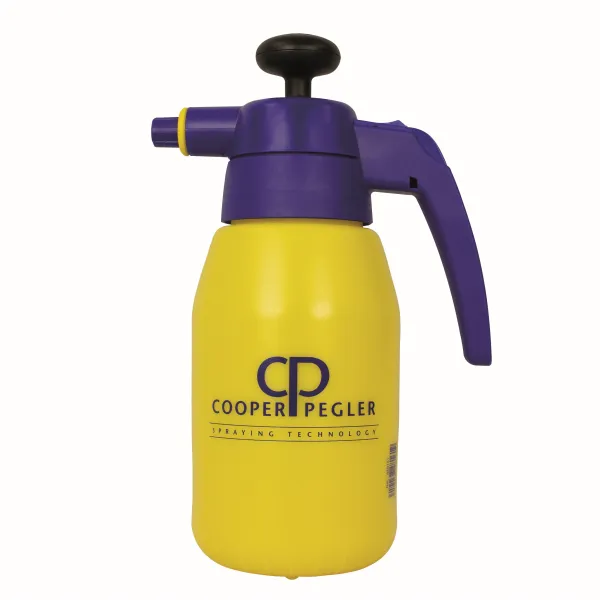
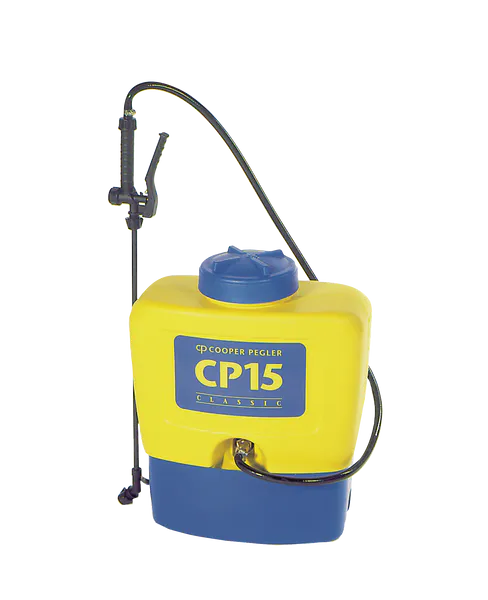
A handheld compression sprayer (Cooper Pegler CP2 MiniPro 1.5 L, 3 bar) and a 15 L diaphragm knapsack (Cooper Pegler CP15 Classic, 1/3 bar control valve)
Capacity is limited by what you can realistically carry, not by what you would like to avoid refilling. Water weighs a kilogram a litre, so a "full day without refilling" sprayer does not exist.
| Capacity | Type | Suits |
|---|---|---|
| 1.5 L | Handheld compression | Spot treatment of individual weeds, small nursery jobs, glasshouse work |
| 5 L | Handheld compression | Small amenity areas, borders, targeted stump treatment |
| 8 L | Handheld compression | The largest practical handheld; grounds maintenance |
| 15 L | Knapsack | The forestry and amenity standard — weed control around young trees, ride maintenance |
| 18 L | Knapsack | Maximum practical capacity; fewer refills where water is a long walk away |
On rough forestry ground, harness quality matters as much as capacity. A padded, reinforced harness with a waist strap and back support transfers load onto the hips instead of hanging it off the shoulders, and over a full day the difference is significant.
Diaphragm or piston pump?
This is the choice that most affects how the sprayer performs, and it is often glossed over.
| Diaphragm pump | Piston pump | |
|---|---|---|
| Pressure | Lower — typically around 1–3 bar | Higher — better reach and finer atomisation |
| Abrasive products | Handles wettable powders and suspensions well, as the pumped liquid does not pass a sliding seal | More vulnerable to wear from abrasive formulations |
| Servicing | Very simple — diaphragms and seal kits are cheap and quick to change | Piston seals need more care and regular greasing |
| Best for | Herbicide application at low pressure, coarse droplets, low drift | Foliar work, taller targets, longer lance reach |
For most forestry weed control — where you want low pressure, coarse droplets and minimal drift — a diaphragm knapsack such as the Cooper Pegler CP15 Classic at £149.00 ex VAT is the right tool. Where you need reach, a piston pump such as the Berthoud Cosmos 18 Pro (£92.50) or the Vermorel 2000 Pro Comfort (£179.00) earns its place.
Which nozzle should I use?
Nozzle choice determines droplet size, spray pattern and drift risk. It is the cheapest and most-neglected way to improve an application.
| Nozzle | Pattern | Use for |
|---|---|---|
| Flat fan (110°) | Tapered fan, even across a boom | Overall herbicide application and boom work |
| Even spray (80°) | Uniform edge-to-edge output | Band spraying along a row of young trees |
| Hollow cone | Fine droplets in a cone | Foliar coverage — insecticides and fungicides where leaf wetting matters |
| Deflector / anvil | Coarse droplets, wide low-pressure fan | Weed control where drift must be minimised |
Two practical rules: coarser droplets drift less, so use the coarsest nozzle that still gives acceptable coverage; and a spray shield or cone guard is far more effective than trying to spray carefully. A spraying guard or cone shield lets you treat right up to the base of a young tree without hitting the tree itself.
Why fit a pressure control valve?
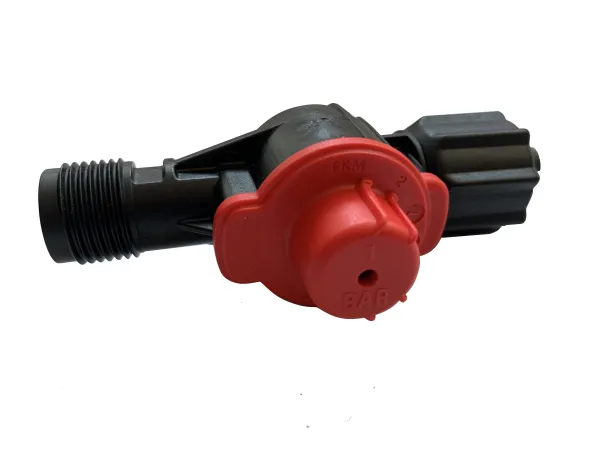
Cooper Pegler Pressure Control Valve: holds the spray pressure at a set figure so the application rate stays constant
Output through a nozzle varies with pressure, so as a hand-pumped knapsack's pressure rises and falls the dose applied to the ground rises and falls with it. A constant flow or pressure control valve holds the pressure at a set figure — typically 1 bar for weed control or 3 bar for foliar work — and simply will not open below it.
The result is a consistent application rate regardless of how enthusiastically the operator is pumping. It is the single upgrade that most improves accuracy on a knapsack, and an anti-drip regulator additionally stops the nozzle dribbling product onto the ground during turns and pauses.
How do you calibrate a knapsack sprayer?
Calibration answers the only question that matters: how much product is actually going onto each hectare? Do it with clean water, in the conditions and at the walking pace you will actually use, and repeat it whenever you change nozzle, pressure or operator.
- Fit the nozzle you will use and pressurise to your working pressure.
- Measure output. Spray into a measuring jug for one minute at working pressure. Record the output in litres per minute.
- Measure the swath. Spray onto dry ground and measure the width of the wetted band in metres, holding the lance at your normal working height.
- Measure your speed. Time yourself walking 50 m at spraying pace. Speed in metres per minute = 50 ÷ (time in seconds) × 60.
- Calculate.
Application rate (L/ha) = (output L/min × 10,000) ÷ (swath width m × speed m/min)
Worked example: output 0.8 L/min, swath 1.0 m, walking speed 50 m/min →
(0.8 × 10,000) ÷ (1.0 × 50) = 160 litres per hectare.The same sum in km/h — the form used on PA1 and PA6 training and in most published calibration sheets:
Application rate (L/ha) = output (L/min) × 600 ÷ speed (km/h) ÷ swath (m)
Same example: 50 m/min is 3.0 km/h, so 0.8 × 600 ÷ 3.0 ÷ 1.0 = 160 litres per hectare. The two forms are algebraically identical — use whichever unit you measure walking speed in.
Compare that figure with the water volume the product label specifies. If it does not match, change one variable at a time — nozzle size first, then pressure, then walking speed — and re-measure. Never adjust the product concentration to compensate for an uncalibrated sprayer.
Maintenance and winterising
- Triple rinse after every use. Rinse the tank, run clean water through the lance and nozzle, and repeat three times. Dried residue is the single commonest cause of blocked nozzles and perished seals.
- Never clear a nozzle by mouth or with wire. Use a soft brush or compressed air; wire damages the orifice and permanently changes the output.
- Grease annually. A silicone grease applied once or twice a year to seals and moving parts keeps the pump smooth and the seals supple.
- Store empty and unpressurised, out of frost. Water left in a pump over winter will split components.
- Keep a service kit for your model on the shelf. Diaphragms, seal kits, trigger filters and hose assemblies are inexpensive; a sprayer out of action in the spraying window is not.
The range and prices
Most buyers arrive already set on a brand, and spares only fit the brand of sprayer you own, so the range is set out by brand below, with the sprayers and the parts kept separate.
Cooper Pegler sprayers
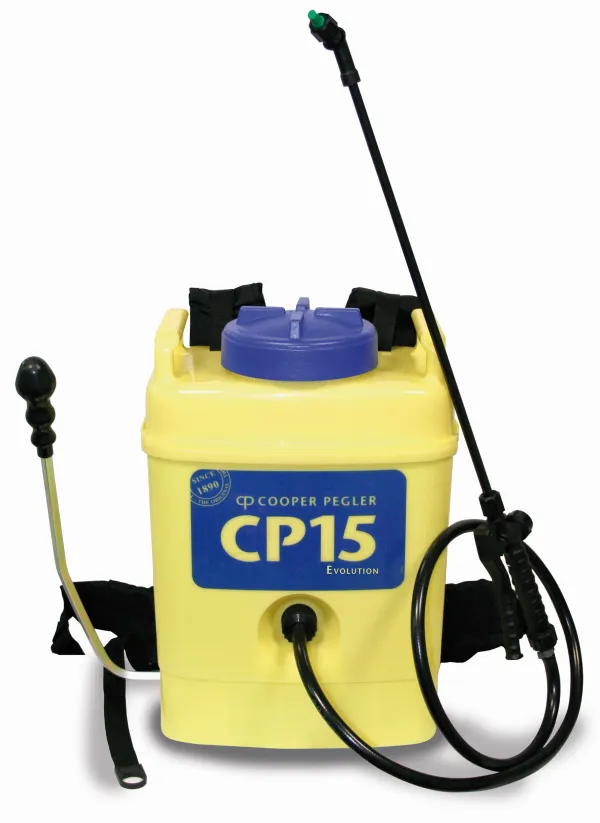
Cooper Pegler CP15 Evolution Comfort: 15 L knapsack, diaphragm pump, reinforced harness with back support
| Product | Type | Price (ex VAT) |
|---|---|---|
| Cooper Pegler CP2 MiniPro 1.5 L | Handheld compression, 3 bar | £17.95 |
| Cooper Pegler CP5 Maxipro 5 L | Handheld, professional trigger with filter | £75.00 |
| Cooper Pegler CP8 Maxipro 8 L | Handheld, professional trigger with filter | £79.00 |
| Cooper Pegler CP15 Classic | 15 L knapsack, diaphragm, 1/3 bar control valve | £149.00 |
| Cooper Pegler CP15 Series 2000 | 15 L knapsack, piston pump, harness | £149.00 |
| Cooper Pegler CP15 Evolution Comfort | 15 L knapsack, diaphragm, reinforced harness with back support | £159.00 |
Berthoud sprayers
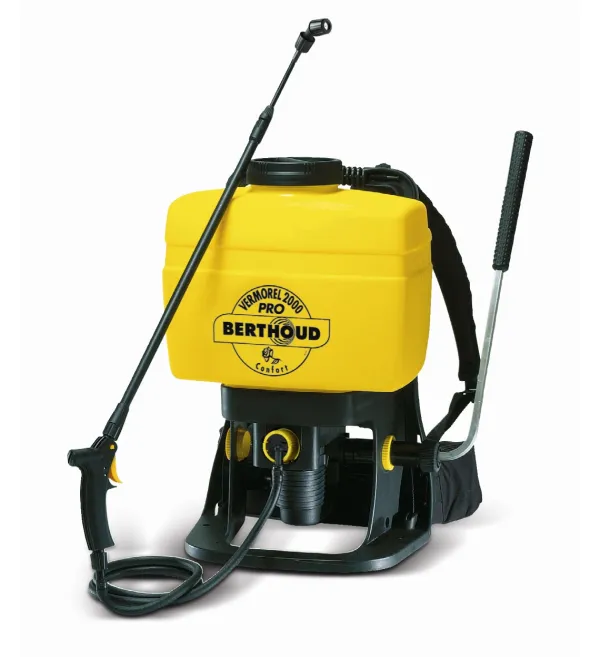
Berthoud Vermorel 2000 Pro Comfort: knapsack with a high-pressure piston pump
| Product | Type | Price (ex VAT) |
|---|---|---|
| Berthoud Cosmos 18 Pro | 18 L knapsack, piston pump | £92.50 |
| Berthoud Vermorel 2000 Pro Comfort | Knapsack, high-pressure piston pump | £179.00 |
Parts and accessories, by brand
Parts are specific to the brand of sprayer you already own. Lances, triggers, nozzles, diaphragms and seal kits are not interchangeable between Cooper Pegler and Berthoud, and often not between models within a range, so order spares against your exact model. Each brand’s accessories page holds its full list.
| Part | Cooper Pegler | Berthoud |
|---|---|---|
| Lances, telescopic lances and nozzle booms 0.4 m to 2.4 m; 2-, 3- and 4-nozzle booms |
Cooper Pegler accessories from £28.25 |
Berthoud accessories from £21.25 |
| Spray shields and guards Cone shields and rectangular guards for targeted treatment |
Cooper Pegler accessories from £38.50 |
Berthoud accessories from £31.00 |
| Nozzle packs Flat fan, even spray, hollow cone, all-treatments, weed control |
Cooper Pegler accessories from £17.50 |
Berthoud accessories from £19.50 |
| Pressure control valves and anti-drop regulators Hold a set pressure for a constant application rate |
Cooper Pegler accessories from £20.25 |
Berthoud accessories from £39.95 |
| Seal kits, diaphragms and service kits Maintenance and repair parts |
Cooper Pegler accessories from £12.35 |
Berthoud accessories from £11.95 |
Prices exclude VAT and were correct on 12 October 2026. See the live category page for current pricing and the full accessory range.
Ready to order? Browse Cooper Pegler sprayers and accessories, Berthoud sprayers and accessories, or the full sprayers range.
Need a specific spare and not sure which fits your model? Call 01727 575460 or email sales@treemarker.co.uk — we can identify parts from the sprayer model.
Sprayers: frequently asked questions
Do I need a certificate to use a knapsack sprayer in the UK?
Professional users of plant protection products in the UK must hold a recognised certificate of competence. For knapsack and handheld equipment this is normally PA1, the foundation module covering legislation, labels, safety and storage, plus PA6, the practical module for pedestrian handheld applicators. Requirements differ for amateur products used domestically — check current guidance with the HSE.
What is the difference between PA1 and PA6?
PA1 is the theory foundation module covering pesticide legislation, label interpretation, personal protective equipment, environmental risk and safe storage. PA6 is the practical module covering the calibration, operation and maintenance of pedestrian handheld applicators such as knapsack sprayers. PA1 must be completed and passed before PA6 certification is awarded.
What size knapsack sprayer should I buy?
Fifteen litres is the standard for forestry and amenity work and 18 litres is the practical maximum. Water weighs a kilogram per litre, so a full 15 L knapsack weighs roughly 18 to 20 kg with the unit — carrying capacity, not tank size, is the real constraint. For spot treatment, a 1.5 to 8 litre handheld compression sprayer is more appropriate.
Is a diaphragm or piston pump better?
A diaphragm pump works at lower pressure, tolerates wettable powders and abrasive formulations well and is simple to service, making it the better choice for herbicide application with coarse, low-drift droplets. A piston pump produces higher pressure for longer reach and finer atomisation, which suits foliar work and taller targets.
How do you calibrate a knapsack sprayer?
Spray clean water into a jug for one minute at working pressure to get output in litres per minute, measure the wetted swath width in metres, and time yourself walking 50 m at spraying pace. Application rate in litres per hectare equals output multiplied by 10,000, divided by swath width multiplied by speed in metres per minute. If you measured speed in km/h instead, the equivalent sum is output × 600 ÷ speed ÷ swath width.
Which sprayer nozzle should I use for weed control?
Use a deflector or anvil nozzle, or a flat fan at low pressure, both of which produce coarse droplets that resist drift. Hollow cone nozzles produce fine droplets for foliar coverage with insecticides and fungicides but drift far more readily. As a general rule, use the coarsest nozzle that still gives acceptable coverage.
What does a pressure control valve do on a knapsack sprayer?
A pressure control valve holds the spray pressure at a set figure, typically 1 bar for weed control or 3 bar for foliar work, and will not open below it. Because nozzle output varies with pressure, this keeps the application rate consistent regardless of how hard the operator is pumping. An anti-drip version also stops the nozzle dribbling during turns and pauses.
How do you clean and store a knapsack sprayer?
Triple rinse after every use — rinse the tank, run clean water through the lance and nozzle, and repeat three times. Never clear a blocked nozzle by mouth or with wire, as wire permanently alters the orifice; use a soft brush or compressed air. Store empty, unpressurised and out of frost, and apply silicone grease to seals once or twice a year.
Can I use a knapsack sprayer near a watercourse?
Only in accordance with the product label and current regulatory requirements. Many plant protection products carry buffer zone restrictions near water, and additional certification applies to some near-water applications. Check the product label and current HSE guidance before spraying anywhere near a ditch, stream, pond or drain — this is one of the most heavily regulated aspects of pesticide use.
Are Cooper Pegler and Berthoud parts interchangeable?
No. Lances, triggers, hoses, nozzles and seal kits are model-specific to each manufacturer and often to particular models within a range. Order spares against your exact sprayer model. If you are unsure which part you need, TreeMarker can identify it from the model details on 01727 575460.
Where can I buy knapsack sprayers and spares in the UK?
TreeMarker supplies Cooper Pegler and Berthoud handheld and knapsack sprayers across the UK and Ireland, together with lances, booms, nozzle packs, shields, seal kits and service parts. Free UK delivery on orders over £120 + VAT, same-day dispatch on stocked items, and purchase orders accepted from councils, colleges and established businesses.
Sources and further reading
- Pesticides — Health and Safety Executive
- FISA Safety Guides — Forest Industry Safety Accord
- Confor — Confederation of Forest Industries
About TreeMarker. TreeMarker is the trading name of Pentaprise Ltd, a UK supplier of forestry and arboriculture equipment established in 2019 and based in Hertfordshire. TreeMarker supplies forestry contractors, woodland owners, estates, local authorities, ecological consultancies and colleges across the UK and Ireland.
Rated 4.9 out of 5 from over 500 reviews on Trustpilot · same-day dispatch on stocked items · free UK delivery on orders over £120 + VAT · purchase orders and proforma invoices accepted · 01727 575460 · sales@treemarker.co.uk