
Forestry Warning Signs: What Your Site Needs and Why
- 12 October 2026
- Peter Greenley
Guides › Forestry Warning Signs · Last updated 12 October 2026 · TreeMarker
A UK forestry worksite normally needs warning signs at every point where the public can enter, plus signs on any haul route used by timber lorries. The legal driver is the duty under the Health and Safety at Work etc. Act 1974 to protect people who are not your employees, supported by the Health and Safety (Safety Signs and Signals) Regulations 1996. TreeMarker supplies 600 × 400 mm weatherproof 4 mm Correx forestry signs from £6.95 ex VAT, singly or in packs of 5 and 10.
Forestry signs at a glance
| Standard size | 600 × 400 mm |
|---|---|
| Material | 4 mm Correx — weatherproof fluted polypropylene board |
| Pack options | Single, pack of 5, pack of 10 |
| Warning sign convention | Yellow triangle, black border and black pictogram |
| Prohibition convention | Red circular band with a diagonal bar |
| Mandatory convention | Blue circle with a white pictogram |
| Symbol standard | BS EN ISO 7010 — the standard that specifies the pictograms themselves |
| Where to place | Every public access point, both approaches on haul routes, and at the worksite boundary |
| Critical rule | Take signs down when the operation finishes |
| Price from | £6.95 ex VAT |
What does the law actually require?
There is no single regulation that says "a felling site must display these signs". The duty is built from several sources, and understanding them tells you what to put up and where.
- Health and Safety at Work etc. Act 1974, section 3. Employers and the self-employed must conduct their undertaking so that people who are not their employees are not exposed to risks to their health or safety. On a woodland site, that means walkers, riders, cyclists, neighbours and passing drivers. Signage is one of the principal ways this duty is discharged.
- Health and Safety (Safety Signs and Signals) Regulations 1996. Where a significant risk remains after other control measures have been applied, a safety sign must be provided. The regulations also set the colour and shape conventions that make signs recognisable.
- Occupiers' Liability Acts 1957 and 1984. These place duties on the occupier of land towards lawful visitors and, in limited circumstances, towards trespassers. Clear warning of an unusual danger is central to meeting them.
- FISA guidance. The Forest Industry Safety Accord publishes the industry's agreed good practice, including guidance on managing public safety on harvesting sites. FISA guidance is not law in itself, but it is the benchmark against which reasonable practice in forestry is judged.
Two things signs do not do. First, a sign does not close a public right of way. If a footpath or bridleway must be closed or diverted for the operation, that requires a formal order from the highway authority, applied for in advance. Second, signs placed on the public highway itself — as opposed to on your land at the entrance — fall under the Traffic Signs Manual regime for works on the highway, and are a different specification from site signage. Correx forestry boards are site signs, not carriageway signs.
Which signs does my operation need?
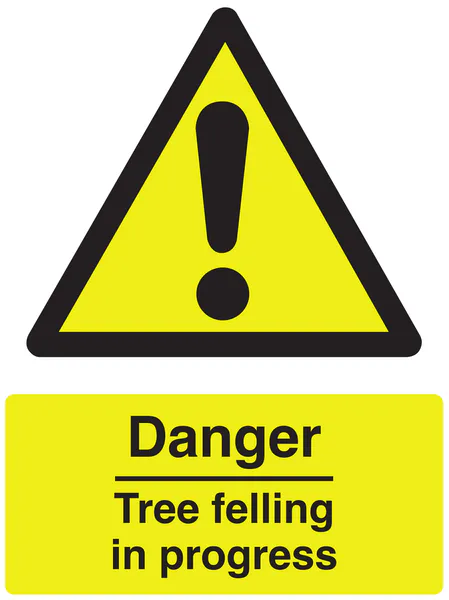
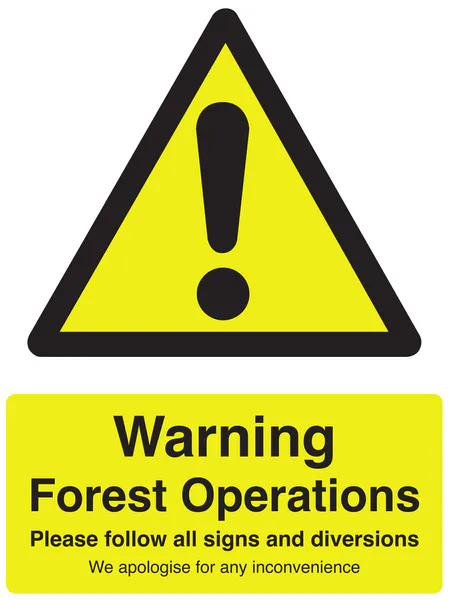
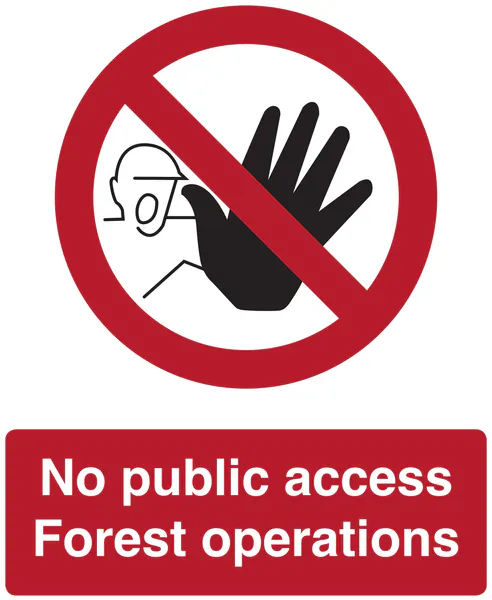
The felling set: Danger Tree Felling In Progress, Warning Forest Operations and No Public Access – Forest Operations
Match the signs to the actual hazards and to who is likely to encounter them. Over-signing is nearly as bad as under-signing: a wall of boards at an entrance gets scanned and ignored, whereas two clear, relevant signs get read.
| Operation | Typical signs |
|---|---|
| Felling / chainsaw work | Danger Tree Felling In Progress · Warning Forest Operations · No Public Access |
| Mechanised harvesting | Warning Forestry Operations Multi Hazard · No Public Access · Warning Heavy Plant Crossing |
| Timber extraction and haulage | Warning Timber Lorries Turning · Warning Mud on Road · Warning Heavy Plant Crossing |
| Roadside stacking / timber yard | Do Not Climb on Timber Stacks · No Unauthorised Persons |
| Herbicide application | Warning Chemical Spraying in Progress |
| Tree surgery in a public area | Warning Tree Surgery · No Unauthorised Persons |
| Tree survey / inspection | Warning Tree Surveying |
| Work near overhead lines | Caution Overhead Cables |
| Private estate / general | Warning Private Land Multi-Hazard · No Unauthorised Persons · CCTV in Operation |
Where should forestry warning signs be placed?
The test is simple: could someone reach the hazard without having passed a sign? If yes, you have a gap.
- Every public access point. Gates, stiles, car parks, forest road entrances, informal paths where people actually enter — not just the ones on the map.
- On any public right of way crossing or approaching the site, at the point where the route enters the affected area, in both directions.
- Both approaches on a haul route. A "Timber Lorries Turning" sign facing one way only warns half the traffic.
- At the worksite boundary, positioned so it is visible before someone is inside the operational area rather than at its edge.
- At eye height and unobstructed. Roughly 1.5 m, clear of vegetation, facing the direction of approach. Check them after wind and after growth — a sign hidden behind bracken in July is not a sign.
Take them down when the operation finishes. This matters more than it sounds. Signs left up after the work has ended teach local users that forestry signs mean nothing, so the next set — protecting a live felling operation — gets walked past. Removing signs promptly is part of making them work.
What do the sign colours mean?
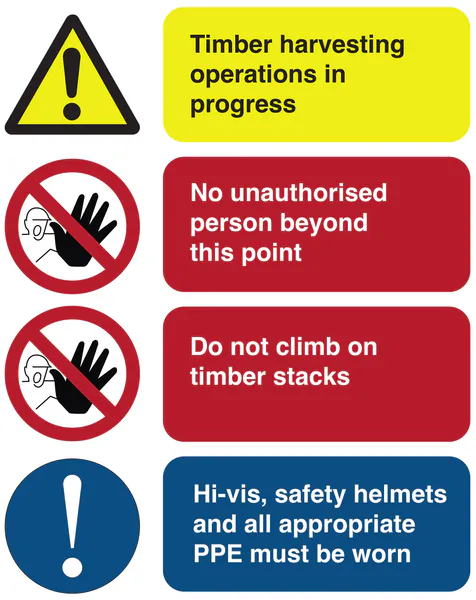
Warning Forestry Operations Multi Hazard: warning (yellow), prohibition (red) and mandatory (blue) panels on one board
The Health and Safety (Safety Signs and Signals) Regulations 1996 set conventions that let a sign be understood at a glance and at distance, before the text is readable.
| Shape and colour | Meaning | Forestry example |
|---|---|---|
| Yellow triangle, black border and pictogram | Warning — be careful, take precautions | Danger Tree Felling In Progress |
| Red circular band with diagonal bar | Prohibition — you must not do this | No Public Access |
| Blue circle, white pictogram | Mandatory — you must do this | Hard hats must be worn |
| Green rectangle or square | Safe condition — emergency route, first aid | First aid point |
Where ISO 7010 fits in
The 1996 Regulations set the shape and colour system above. BS EN ISO 7010 is the separate standard that specifies the graphical symbols — the pictograms — that go inside those shapes. Its purpose is that the symbol means the same thing to everyone, regardless of the language they read, which matters on sites with contractors from mixed backgrounds.
One practical point specific to forestry: ISO 7010 has no dedicated pictogram for "tree felling in progress", or for most forestry operations. That is why forestry signage is text-led, and why the great majority of forestry warning signs carry the general warning symbol — a black exclamation mark in a yellow triangle, catalogued as W001 — with the specific hazard spelled out in words underneath. A sign built this way is doing exactly what the standard intends: recognised symbol for "warning", plain text for the particular danger.
When buying signage, ISO 7010 compliance means the triangle, border and symbol match what people already recognise from every other worksite. It is worth having, but it is the symbol that is standardised, not the wording.
How long does a Correx sign last outdoors?
Correx is fluted polypropylene board — light, completely waterproof, and stiff enough to stay flat on a post. It will not soften, warp or delaminate in rain the way a printed card or an untreated timber board does.
Realistically, a 4 mm Correx sign gives good service for a season and often considerably longer. The limiting factor is UV: over extended exposure the print fades and the board becomes more brittle, particularly on a south-facing aspect. For the duration of a typical felling or harvesting operation this is a non-issue, and the low unit cost means signs can be treated as consumables rather than assets — which is the right way to think about them, because a faded, cracked sign undermines the message.
Fixing signs
- Cable ties to a stake, post or gate are the standard method — quick, secure and easy to remove cleanly at the end of the job.
- Punch your own holes if the board is not pre-drilled; Correx punches easily without splitting.
- Do not nail signs to trees you intend to fell or mill. Steel fixings left in a stem damage chainsaw chains and mill blades, exactly as with tree tags. Use a stake.
- Carry spares. Signs get taken, blown down and damaged. A pack of 10 costs less than an hour of downtime spent driving out for a replacement.
Site signage checklist
- Signs at every point of public access, not just the main entrance
- Correct signs for the actual operation — felling, harvesting, haulage, spraying
- Both directions covered on haul routes and paths
- Any public right of way properly addressed — with a formal closure or diversion order if required
- Signs at eye height, clear of vegetation, facing the direction of approach
- Contact details available for enquiries or complaints
- Spare signs and cable ties on the vehicle
- Signs checked during the operation and removed when it ends
Prices exclude VAT and were correct on 12 October 2026. See the live category page for current pricing and the full range of sign wordings.
Ready to order? Browse all forestry warning signs, or see the wider health & safety category for barrier tape and first aid kits.
Need a wording we do not list, or a bulk quantity for an estate? Call 01727 575460 or email sales@treemarker.co.uk.
Forestry warning signs: frequently asked questions
What signs do I need for a tree felling site in the UK?
A felling site normally needs "Danger Tree Felling In Progress" and "No Public Access" signs at every point the public can enter, plus "Warning Forest Operations" at the site boundary. Where timber is extracted by road, add "Warning Timber Lorries Turning" and "Warning Mud on Road" on both approaches. Match the signs to the actual hazards present.
Are forestry warning signs a legal requirement?
There is no single regulation listing required forestry signs, but the duty is clear. Section 3 of the Health and Safety at Work etc. Act 1974 requires you not to expose non-employees to risk, and the Health and Safety (Safety Signs and Signals) Regulations 1996 require a safety sign where a significant risk remains after other controls. Signage is a principal means of meeting both.
What size are forestry warning signs?
The standard forestry warning sign supplied by TreeMarker is 600 × 400 mm on 4 mm weatherproof Correx board, available singly or in packs of 5 and 10 from £6.95 ex VAT. That size is large enough to be read from a vehicle at a track entrance while remaining easy to carry and quick to fix to a stake or gate.
What is Correx and how long does it last outdoors?
Correx is fluted polypropylene board — light, fully waterproof and stiff enough to stay flat on a post, unlike printed card or untreated timber. A 4 mm Correx sign gives good service for a season and often longer. The limiting factor is UV exposure, which gradually fades the print and embrittles the board, particularly on south-facing aspects.
Where should forestry warning signs be placed?
At every public access point including informal paths, on both approaches of any haul route, where a public right of way enters the affected area, and at the worksite boundary. Fix them at around eye height, clear of vegetation and facing the direction of approach. The test is whether anyone could reach the hazard without passing a sign.
Can I close a public footpath with a warning sign?
No. Closing or diverting a public right of way requires a formal order from the highway authority, applied for in advance of the operation. Warning signs advise people of a hazard; they do not remove the public's legal right to use the path. Plan any required closure or diversion well before work starts.
What do the colours on safety signs mean?
Under the Health and Safety (Safety Signs and Signals) Regulations 1996, a yellow triangle with a black border means warning, a red circular band with a diagonal bar means prohibition, a blue circle means a mandatory action such as wearing a hard hat, and green indicates a safe condition such as a first aid point or escape route.
Do forestry warning signs need to comply with ISO 7010?
BS EN ISO 7010 standardises the graphical symbols used on safety signs, so a pictogram means the same thing in any language. It is good practice rather than a standalone legal duty. ISO 7010 contains no dedicated symbol for forestry operations, so most forestry signs pair the general warning symbol — a black exclamation mark in a yellow triangle, catalogued as W001 — with the specific hazard written out in text.
How do you fix forestry signs on site?
Cable ties to a stake, post or gate are the standard method — quick, secure and easy to remove cleanly at the end of the job. Correx punches easily if the board is not pre-drilled. Avoid nailing signs to trees you intend to fell or mill, because steel fixings left in a stem damage chainsaw chains and sawmill blades.
Should I take warning signs down after the work is finished?
Yes, promptly. Signs left in place after an operation ends teach local users that forestry signs can be ignored, so the next set protecting a live felling site gets walked past. Removing signs as soon as the hazard has gone is part of making the signage effective, and is expected good practice.
Do I need signs for herbicide spraying in woodland?
Where the public may access the treated area, a "Warning Chemical Spraying in Progress" sign should be displayed at access points for the duration of the operation and any re-entry period specified on the product label. This sits alongside your other obligations as a professional user, including certification, COSHH assessment and label compliance.
Where can I buy forestry warning signs in the UK?
TreeMarker supplies 600 × 400 mm weatherproof 4 mm Correx forestry warning signs across the UK and Ireland in 16 wordings, singly or in packs of 5 and 10, from £6.95 ex VAT. Free UK delivery on orders over £120 + VAT, same-day dispatch on stocked items, and purchase orders accepted from councils, colleges and established businesses.
Sources and further reading
- Safety Signs — UK Forest Industry Safety Accord (FISA)
- FISA Safety Guides — including guidance on managing health and safety in forestry
- Managing public safety on harvesting sites (FCPN019) — Forestry Commission Practice Note
- Safety signs and signals (L64) — HSE guidance on the 1996 Regulations
About TreeMarker. TreeMarker is the trading name of Pentaprise Ltd, a UK supplier of forestry and arboriculture equipment established in 2019 and based in Hertfordshire. TreeMarker supplies forestry contractors, woodland owners, estates, local authorities, ecological consultancies and colleges across the UK and Ireland.
Rated 4.9 out of 5 from over 500 reviews on Trustpilot · same-day dispatch on stocked items · free UK delivery on orders over £120 + VAT · purchase orders and proforma invoices accepted · 01727 575460 · sales@treemarker.co.uk
This guide is general information about signage products and is not legal advice. Responsibility for assessing the risks of a specific operation rests with the duty holder.