
Forestry Gauges & Probes: Which Instrument Do You Need?
- 28 September 2026
- Peter Greenley
Guides › Gauges & Probes · Last updated 28 September 2026 · TreeMarker
Forestry gauges and probes are the field instruments used to measure a standing tree without felling it. Between them they cover diameter (calipers), height and angle (clinometers and hypsometers), stand density (relascopes and factor gauges), bark thickness (bark gauges), internal decay (sounding mallets and decay probes) and distance (thread meters). TreeMarker stocks Haglöf, Suunto and IML instruments from £31.00 ex VAT.
What each instrument measures
| Instrument | Measures | Typical use |
|---|---|---|
| Calipers | Stem diameter directly | Fast DBH measurement on a tally or inventory |
| Relascope / wedge prism | Basal area per hectare | Rapid point sampling to estimate stand density and volume |
| Factor gauge | Basal area per hectare | The simplest, cheapest way to run a basal area sweep |
| Optical clinometer | Angle, slope and tree height | Height measurement at a known horizontal distance |
| Electronic clinometer | Angle and height, with calculation built in | Height without doing the trigonometry by hand |
| Ultrasonic hypsometer | Height, distance and angle | Accurate height inside a stand, where line of sight is obstructed |
| Bark gauge | Bark thickness, 0–50 mm | Converting over-bark diameter to under-bark timber volume |
| Decay probe | Depth and extent of internal decay | Investigating a cavity or suspected decay column |
| Sounding mallet | Acoustic response of the stem | First-pass check for hollowing during a tree inspection |
| Thread meter | Horizontal distance walked | Setting out plots, transects and measurement baselines |
| Soil sampler | Soil profile core | Site assessment and species selection before planting |
How do you measure tree diameter accurately?
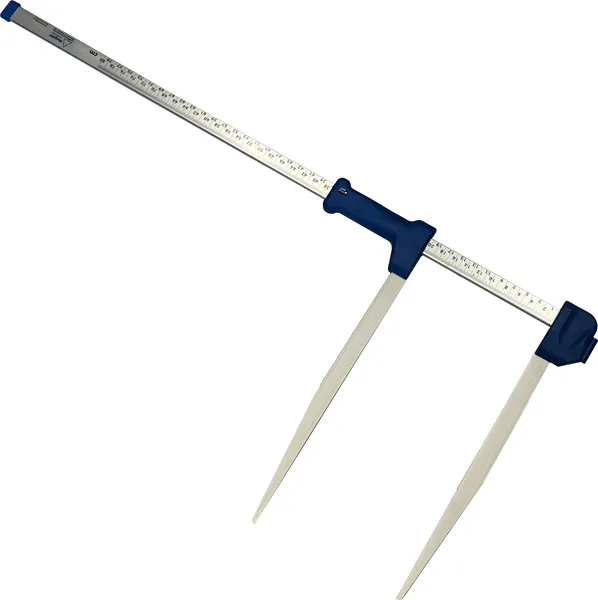
Haglöf Mantax Blue Calipers: reads diameter directly to 80 cm
In UK forestry, diameter at breast height (DBH) is measured at 1.3 m above ground level, and trees under 7 cm DBH are conventionally classed as unmeasurable. These conventions come from the Forestry Commission's Forest Mensuration handbook (Matthews and Mackie, 2006), the standard UK reference. Two instruments do the job, and they are not interchangeable.
Calipers are faster. A pair of Haglöf Mantax Blue calipers reads diameter directly to 80 cm and a competent operator can tally a plot quickly. Because stems are rarely round, best practice is to take two readings at right angles and average them — a single caliper reading on an oval stem can be several centimetres out.
Diameter tapes are slower but more consistent. A girth tape wraps the whole circumference and converts it to diameter (its scale is stretched by π, so the figure you read is the diameter itself), which effectively averages any irregularity in one pass. Tapes are the better choice for irregular, fluted or buttressed stems and for permanent plots where repeatability between different operators matters more than speed.
On a slope, measure 1.3 m from the ground on the upper side of the stem. On a leaning tree, measure 1.3 m along the lean rather than vertically. Where a tree forks below 1.3 m, it is normally recorded as two stems.
How do you measure tree height?
All height measurement works the same way: measure the horizontal distance to the tree, measure the angle to the top and to the base, and let trigonometry do the rest. The instruments differ in how much of that they do for you and how well they cope with obstructed sightlines.
Optical clinometers
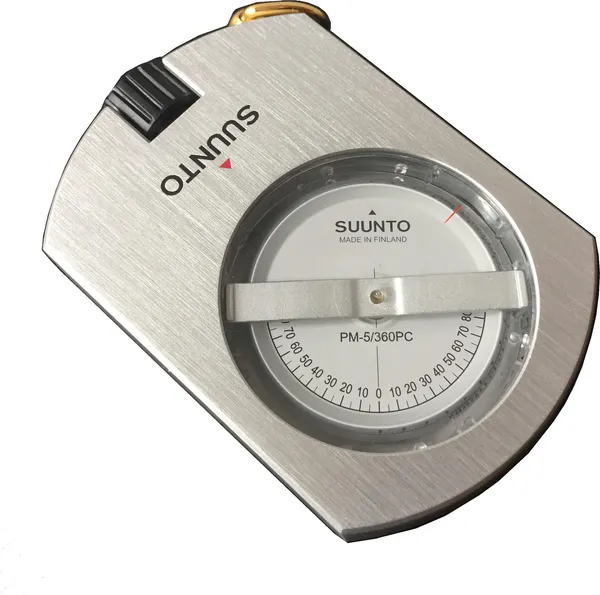
Suunto PM-5/360 PC Clinometer: optical, with degree and percent scales, from any known distance
A Suunto PM-5 is read through the eyepiece against a scale calibrated for a fixed horizontal distance — the PM-5/1520 has height scales for 15 m and 20 m (and a percent scale), the PM-5/360 PC reads in degrees and percent. You pace or tape out the distance, sight the top and the base, and add or subtract the readings. They are robust, need no batteries, cost from £139.00 ex VAT, and will still be working in twenty years. The limitation is that you must establish the horizontal distance yourself and hold to it.
Suunto PM-5/1520 height meter or PM-5/360 PC clinometer?
This is the question TreeMarker is asked most often about clinometers, because the two instruments look identical and cost the same. Both are the same liquid-damped Suunto PM-5 body, read through the eyepiece with both eyes open; the difference is the scale card inside, and so how you get from a reading to a height.
PM-5/1520 height meter. Two of its three scales give tree height directly in metres for fixed horizontal distances of 15 m and 20 m (double the reading at 30 m or 40 m). Tape out the distance, sight the top of the tree and read the height; then sight the base and add that reading if the base is below eye level, or subtract it if the base is above. On level ground you can simply add your eye height, about 1.6 m, to the top reading. No arithmetic beyond that, which makes it the quicker instrument for plantation and inventory work at a set distance. A nomogram on the supplied card corrects the height where the distance cannot be measured horizontally. The third scale reads slope in percent and is printed in tens (0 to 15 for 0 to 150 percent): a reading of 4 is 40 percent. It is graduated in 1 percent steps up to 70 percent and 2 percent steps above, and the numbers close up towards the top of the card.
PM-5/360 PC clinometer. Its scales read angle in degrees (0 to ±90°) and slope in percent (0 to ±150%), so it works from any known horizontal distance: height = (top reading % ± base reading %) × distance ÷ 100, adding the base reading when the base is below eye level and subtracting it when the base is above. From 25 m, a top reading of 41% and a base reading of 13% give (41 + 13) ÷ 100 × 25 = 13.5 m. There is a little arithmetic, but the instrument is not tied to one distance and doubles as a general clinometer for ride gradients, extraction routes, slope surveys and roof pitches. Both scales read directly, with no multiplier: degrees in 1° steps, percent in 1 percent steps up to 70 percent and 2 percent steps above.
Choose the 1520 if you will always measure from a taped 15 or 20 m and want the fastest reading; choose the 360 PC if your distances vary, you measure distance with a rangefinder or thread meter, or you also need slope angles. Both are £139.00 ex VAT, need no batteries, and on sloping ground both need the same correction (true height = observed height × the cosine of the slope angle, or the nomogram).
| Feature | PM-5/1520 height meter | PM-5/360 PC clinometer |
|---|---|---|
| Scales | Height in metres for 15 m and 20 m, plus percent printed in tens (0 to 15 for 0 to 150%) | Degrees (±90°) and percent (±150%), both read directly |
| Working distance | 15 m or 20 m (double at 30 m or 40 m) | Any known horizontal distance |
| Arithmetic | Add or subtract the base reading | (top % ± base %) × distance ÷ 100 |
| Also useful for | Gradients, from the percent scale (reading × 10) | Any slope or angle: ride gradients, roof pitch, geology |
| Price (ex VAT) | £139.00 | £139.00 |
Electronic clinometers
The Haglöf ECII D at £242.00 ex VAT adds height calculation, so you enter or measure the distance and it returns the height directly. Fewer arithmetic errors, faster on a long tally.
Ultrasonic hypsometers
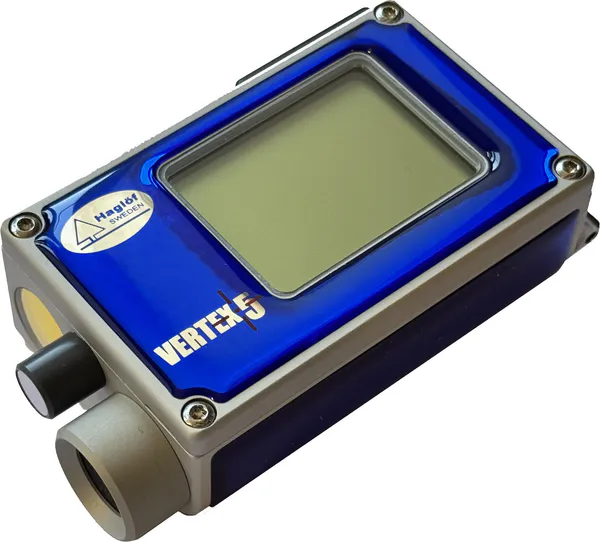
Haglöf Vertex 5 Ultrasonic Hypsometer: height, distance and angle measured to a transponder, through foliage
The Haglöf Vertex is the professional standard and the reason is worth understanding: it measures distance using an ultrasonic pulse to a transponder placed on the tree, and ultrasound travels through foliage and understorey. A laser rangefinder needs clear line of sight and will happily return the distance to a branch, a bramble or the wrong tree. Inside a dense stand — which is where most UK forest mensuration happens — the ultrasonic approach is markedly more reliable. The Vertex also self-calibrates for air temperature, which affects the speed of sound.
The Vertex 5 instrument alone is £1,380.00 ex VAT and needs at least one T4 transponder (£370.00). The better buy for a first user is the Vertex 5 kit at £1,520.00 ex VAT, which packs the instrument, a T4 transponder, the 360° adapter and a monopod staff into a robust protective carry case — everything needed to start measuring, for £230 less than the instrument and transponder bought separately. It is an investment aimed at people measuring trees professionally and regularly.
What is basal area, and how does a relascope work?
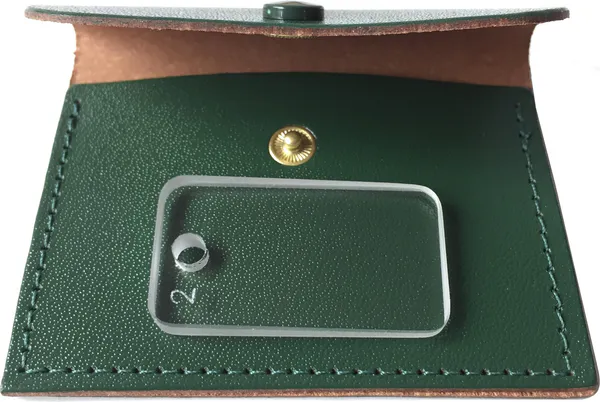
Wedge Prism Relascope: clear glass prism in BAF 2, 3 or 4; BAF 2 is the UK standard
Basal area is the total cross-sectional area of all tree stems at breast height on a hectare of ground, expressed in square metres per hectare. It is the single most useful measure of how heavily stocked a stand is, and it drives thinning decisions and volume estimates.
A relascope, wedge prism or factor gauge measures it by angle count sampling, which is elegantly simple:
- Stand at a sample point and sight each surrounding tree at breast height through the gauge.
- Count every tree that appears wider than the gauge's aperture or prism offset — these are "in" trees. Borderline trees are counted every other time, which is the same as counting each as a half.
- Multiply the count by the basal area factor (BAF).
So a sweep with a BAF 2 prism that counts 14 "in" trees gives a basal area of 14 × 2 = 28 m²/ha. No plot boundary to lay out, no measuring, no tape. It is the fastest inventory technique in forestry. The field procedure for basal area and thinning yield is set out in the Forestry Commission's Thinning Control Field Guide.
Using a wedge prism well takes a little practice. Hold the prism over the sampling point (it can be any comfortable distance from your eye), keep it vertical and square to the line of sight, and count only stems of 7 cm dbh or more. Count a borderline stem every other time. On a slope, multiply the count by the secant of the slope angle (the Forestry Commission field guide tabulates it) or tilt the top edge of the prism through the slope angle.
Choosing a BAF is a trade-off: a lower factor counts more trees per point (better precision, slower), a higher factor counts fewer (faster, coarser). BAF 2 is the UK standard. The Forestry Commission's thinning control procedure is written for factor 2 (its table of edge distances covers only factors 2 and 0.5), and about nineteen in twenty of the wedge prisms TreeMarker sells are BAF 2. The reason is stand structure: British plantations carry many relatively small stems, and a small factor counts enough of them at each point for a reliable estimate. BAF 3 and 4 suit bigger, more widely spaced trees, which is why larger factors are the norm in North American cruising. The Cruisers Crutch relascope at £43.95 ex VAT offers variable BAF 2–6 plus slope compensation from 0% to 90% in 5% increments, which removes the manual slope correction a fixed gauge needs.
Why measure bark thickness?
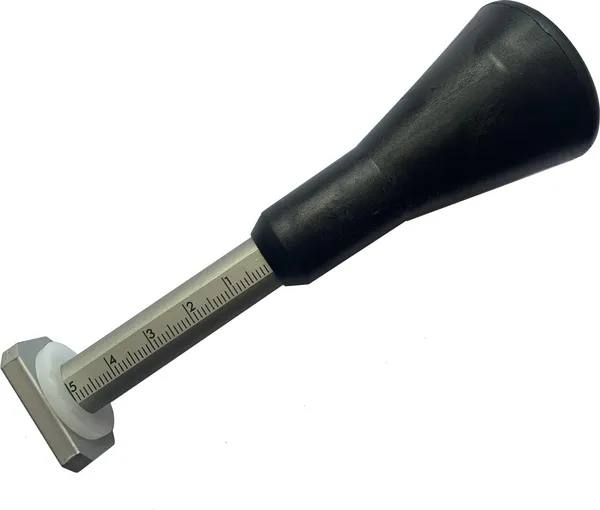
Haglöf Bark Gauge (Metric): reads bark thickness directly, 0 to 50 mm
Calipers and tapes measure over bark. Timber is bought and sold under bark. On a mature conifer the difference is not trivial — bark can be 10–20 mm on each side of the stem, which compounds into a meaningful volume error across a whole coupe.
A bark gauge is pushed through the bark until it meets wood, and reads the thickness directly. The Haglöf metric bark gauge covers 0–50 mm at £73.00 ex VAT. Take several readings around the stem and average them, since bark thickness varies with aspect and stem form.
Decay probes and sounding mallets
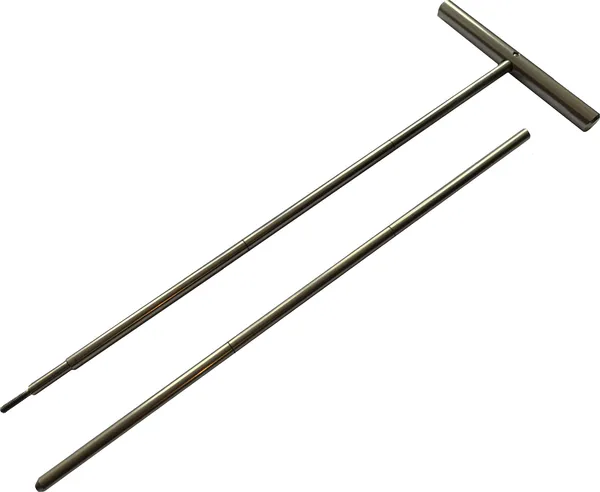
IML Tree Probe: 7 mm by 600 mm steel rod for probing cavities and decay
These belong to tree inspection rather than mensuration, and they answer a different question: how much sound wood is left?
A nylon sounding mallet is the first-pass tool. Tapping around the stem, a solid ring indicates sound wood and a dull or hollow note suggests a cavity or decay column. Nylon faces are used because they will not bruise the bark the way a steel hammer does. The Thorex 710/712 has screw-in replaceable nylon faces, from £26.95 ex VAT.
An IML tree probe follows up. It is a fine steel probe — 7 mm diameter, 600 mm standard, extendable in 300 mm sections — pushed into an existing cavity or opening to establish how far the decay extends and where the sound wall begins. From £31.00 ex VAT.
Both are diagnostic aids, not substitutes for a qualified assessment. Where a probe indicates significant loss of sound wood, the next step is normally instrumented decay detection and a formal risk assessment by a competent arboriculturist.
Building a kit
| Job | Minimum sensible kit | Indicative cost (ex VAT) |
|---|---|---|
| Occasional woodland owner | Diameter tape + factor gauge | from around £60 |
| Tree inspection / arb survey | Diameter tape + clinometer + sounding mallet + decay probe | from around £220 |
| Arborist moving into tree surveys | Tree tags + DBH tape + clinometer + wedge prism relascope + IML tree probe | from around £260 |
| Inventory / timber cruise | Calipers + relascope + optical clinometer + thread meter | from around £500 |
| Professional mensuration | Calipers + Vertex 5 kit (T4 transponder and carry case included) + bark gauge | from around £1,750 |
The range and prices
The range is set out by instrument type, in the order the table at the top uses; within each type the products run from the least to the most expensive, with an accessory directly under the instrument it belongs to.
Calipers
| Product | Detail | From (ex VAT) |
|---|---|---|
| Haglöf Mantax Blue Calipers | Reads diameter directly to 80 cm | £158.00 |
Relascopes and factor gauges
| Product | Detail | From (ex VAT) |
|---|---|---|
| Haglöf Factor Gauge (Metric) | Transparent plate with a fixed aperture; the simplest basal area tool | £37.95 |
| Wedge Prism Relascope | Clear glass prism, 2, 3 or 4 BAF; BAF 2 is the UK standard | £39.95 |
| Cruisers Crutch Relascope | 2, 3, 4, 5 and 6 BAF, with slope compensation | £43.95 |
Clinometers and hypsometers
| Product | Detail | From (ex VAT) |
|---|---|---|
| Suunto PM-5/360 PC Clinometer | Optical; reads in degrees and percent, from any known distance | £139.00 |
| Suunto PM-5/1520 Optical Height Meter | Optical; height scales for 15 m and 20 m, plus percent | £139.00 |
| Suunto Tandem 360PC/360R Clinometer/Compass | Clinometer and compass in one body | £199.00 |
| Haglöf ECII D Electronic Clinometer | Angle and height, with the calculation built in | £242.00 |
| Haglöf Vertex 5 Ultrasonic Hypsometer | Height, distance and angle; measures to a transponder through foliage. Instrument only | £1,380.00 |
| Haglöf Vertex 5 Kit | Instrument, T4 transponder, 360° adapter and monopod staff in a protective carry case — the better first-user buy | £1,520.00 |
| Haglöf T4 Ultrasonic Transponder | Needed with the Vertex — at least one per user; included in the kit | £370.00 |
Bark gauges, probes and mallets
| Product | Detail | From (ex VAT) |
|---|---|---|
| Thorex Nylon Sounding Mallet | 1 lb, screw-in replaceable nylon faces | £26.95 |
| IML Tree Probe | 7 mm × 600 mm steel rod for probing cavities and decay | £31.00 |
| Haglöf Bark Gauge (Metric) | Reads bark thickness directly, 0–50 mm | £73.00 |
Distance and soil
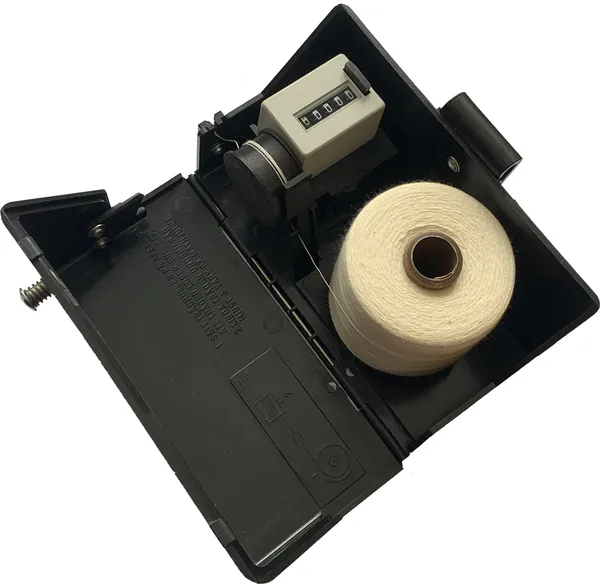
Haglöf Walktax Thread Meter: measures the horizontal distance walked, by thread; metric
| Product | Detail | From (ex VAT) |
|---|---|---|
| Haglöf Solitax Soil Sampler | Soil profile corer for site assessment | £115.00 |
| Haglöf Walktax Thread Meter | Measures the horizontal distance walked, by thread; metric | £167.00 |
| Walktax Measuring Thread | Replacement thread for the Walktax | £12.25 |
Reference books
| Product | Detail | From (ex VAT) |
|---|---|---|
| Thinning Control Field Guide | Forestry Commission 2015; yield class, thinning yield and the field procedures for top height, basal area and volume marked | £14.00 |
| Forest Mensuration: A Handbook for Practitioners | Matthews and Mackie, Forestry Commission 2006; the standard UK reference for every procedure in this guide | £26.00 |
Prices exclude VAT and were correct on 28 September 2026. See the live category page for current pricing.
Ready to order? Browse clinometers and height meters, hypsometers, relascopes, the gauges & probes range, or measuring tapes.
Not sure which instrument fits your survey method? Call 01727 575460 or email sales@treemarker.co.uk.
Gauges & probes: frequently asked questions
At what height is tree diameter measured in the UK?
Diameter at breast height (DBH) is measured at 1.3 m above ground level in the UK, in line with the convention used across Europe and recommended by the FAO. On sloping ground, measure 1.3 m from the ground on the upper side of the stem. On a leaning tree, measure 1.3 m along the lean rather than vertically.
What is a relascope used for?
A relascope is used for angle count sampling to estimate basal area per hectare without laying out a plot. The operator sights each surrounding tree at breast height and counts those appearing wider than the gauge's aperture, then multiplies the count by the basal area factor. A count of 14 with a BAF 2 prism, the usual UK factor, gives 28 square metres per hectare.
What does BAF mean on a wedge prism?
BAF stands for basal area factor. It is the multiplier applied to the number of "in" trees counted in an angle count sweep to give basal area in square metres per hectare. BAF 2 is the UK standard and counts more trees per point for better precision in stands of small stems; BAF 3 or 4 count fewer trees and suit larger, more widely spaced trees.
How do you use a wedge prism relascope?
Stand at the sampling point and hold the prism over it, at any comfortable distance from your eye, vertical and square to the line of sight. Sight each surrounding stem at breast height: if the displaced image still overlaps the stem it is "in", if it is completely offset it is "out", and a borderline stem is counted every other time. Make a full 360° sweep counting stems of 7 cm dbh or more, correct the count for slope, and multiply by the prism's basal area factor to get square metres per hectare. Average several sweeps across the stand.
Should I use calipers or a diameter tape?
Calipers are faster and suit high-volume tallies on reasonably round stems, but should be used as two readings at right angles and averaged. A diameter tape is slower but more consistent, because wrapping the full circumference averages out stem irregularity in one pass. Use a tape for fluted or buttressed stems and for permanent plots measured by different operators.
What is the difference between a clinometer and a hypsometer?
A clinometer measures angle or slope, and you supply the horizontal distance yourself to derive tree height. A hypsometer such as the Haglöf Vertex measures the distance as well — ultrasonically, to a transponder on the tree — and returns height directly. The practical advantage is that ultrasound works through foliage, where a laser needs clear line of sight.
What is the difference between the Suunto PM-5/1520 and the PM-5/360 PC?
Both are the same optical Suunto PM-5 clinometer body; only the scale card differs. The PM-5/1520 height meter reads tree height directly in metres from fixed horizontal distances of 15 m or 20 m (double the reading at 30 or 40 m), so there is no arithmetic beyond adding or subtracting the base reading; its third scale reads percent, printed in tens (a reading of 4 is 40 percent). The PM-5/360 PC clinometer reads angle in degrees (to ±90°) and slope in percent (to ±150%, read directly), so it works from any known distance — height is (top percent ± base percent) × distance ÷ 100 — and doubles as a general slope meter. Both cost the same; choose the 1520 for speed at a set distance and the 360 PC for flexibility.
Why does the Haglöf Vertex use ultrasound instead of a laser?
Ultrasonic pulses travel through foliage and understorey to a transponder mounted on the tree, so the instrument measures the distance to that specific tree even inside a dense stand. A laser rangefinder needs an unobstructed line of sight and can return the distance to intervening branches or the wrong stem, which is a common source of error in closed-canopy woodland.
Why do foresters measure bark thickness?
Calipers and diameter tapes measure over bark, but timber is traded under bark. On mature conifers bark can be 10 to 20 mm on each side of the stem, which produces a significant volume error across a whole coupe. A bark gauge is pushed through to the wood and reads thickness directly, typically over a 0 to 50 mm range, with several readings averaged per stem.
What is a tree sounding mallet for?
A sounding mallet is tapped around a stem during a tree inspection to listen for changes in the acoustic response. A solid ring indicates sound wood; a dull or hollow note suggests a cavity or decay column that warrants further investigation. Nylon faces are used rather than steel because they do not bruise or mark the bark.
How does a tree decay probe work?
A tree decay probe is a fine steel rod, typically 7 mm diameter and 600 mm long with 300 mm extensions, inserted into an existing cavity or opening to establish how far decay extends and where sound wood begins. It is a diagnostic aid used alongside visual assessment, not a replacement for instrumented decay detection or a formal risk assessment.
What is a factor gauge and is it worth it over a relascope?
A factor gauge is a simple transparent plate with a fixed aperture used for angle count sampling, and at around £37.95 ex VAT it is the cheapest route to basal area measurement. A relascope adds variable basal area factors and, on models such as the Cruisers Crutch, automatic slope compensation. For occasional use a factor gauge is adequate; for regular inventory on sloping ground a relascope saves time and reduces error.
What instruments do I need for a woodland inventory?
A workable inventory kit is calipers or a diameter tape for DBH, a relascope or factor gauge for basal area, a clinometer or hypsometer for height, and a thread meter or tape for distance and plot layout. A bark gauge is added where under-bark timber volume matters. TreeMarker supplies Haglöf, Suunto and IML instruments across this range.
What kit do I need to start doing tree surveys?
The starter kit most arborists buy when they move from climbing into surveying is tree tags to number the trees, a DBH tape, a Suunto clinometer for heights, a wedge prism relascope for basal area and an IML probe for checking decay, from around £260 ex VAT — the list TreeMarker gave Pro Arb magazine for its 2023 feature on arborists making that switch. Add a sounding mallet for inspections, and calipers or a factor gauge as the work grows.
Sources and further reading
- How do foresters measure trees? — Royal Forestry Society
- Woodland Carbon Code — carbon assessment protocol and measurement conventions
- When a felling licence is needed — GOV.UK / Forestry Commission
- How to use a wedge prism relascope to measure basal area — Gabriel Hemery
- Routes to a Successful Survey — Pro Arb magazine, August/September 2023, page 40: arborists moving from climbing into tree surveys, with TreeMarker on the starter kit
About TreeMarker. TreeMarker is the trading name of Pentaprise Ltd, a UK supplier of forestry and arboriculture equipment established in 2019 and based in Hertfordshire. TreeMarker supplies forestry contractors, woodland owners, estates, local authorities, ecological consultancies and colleges across the UK and Ireland.
Rated 4.9 out of 5 from over 500 reviews on Trustpilot · same-day dispatch on stocked items · free UK delivery on orders over £80 + VAT · purchase orders and proforma invoices accepted · 01727 575460 · sales@treemarker.co.uk